
against endlessness
amilton de azevedo writes about Vampyr, by Manuela Infante (Chile), presented in the 2026 Festival TransAmériques (FTA – Tiohtià:ké/Montreal). the critic traveled to Canada at the invitation of the FTA and integrates the Playgrounds program with Critical Harvests.
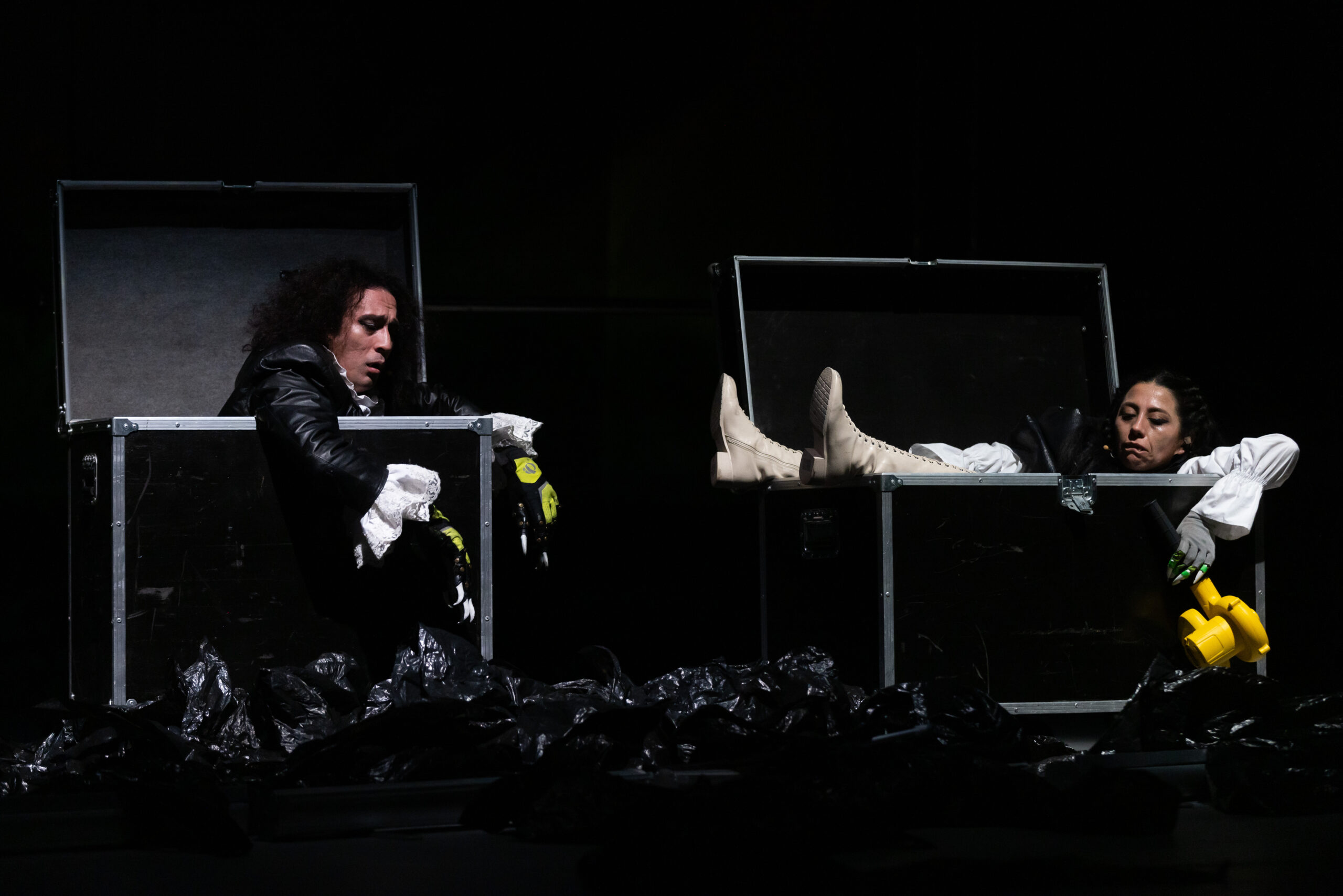
Not caskets nor coffins: flight cases. Manuela Infante’s Vampyr characters arise from the (not-so-)dead towards the (not-so-)alive throughout theatre. Instead of a graveyard, the stage. The set kind of initially resembles a chroma-key, in what seems one of many investments that the work operates in order to evidence and reiterate its theatricality. Later, Rocio Hernández’s set, props and lightning will show us the sky – but a deeply cloudy one, colorshifting, eerie.
In a world-building gesture, Infante’s work establishes from the beginning its own logic: awkward, funny, unsettling, maybe even disturbing, those two figures – performed by David Gaete and Marcela Salinas – are in front of the audience to arrange the place for the report of the energy company responsible for the wind turbines in order to clarify what happened there. They are workers of the wind farm. And bats. Also, vampires. All of that, none of that, half of anything or half of everything; the living, the dead, the damned. Vampyr produces uncertainty as it unfolds. Metaphors become clearer, the critical discourse can be understood and Infante’s intricate playwright operates unsuspicious connections. But at the same time, there is always something more to (un)know.
- Read more: access this link for more theater critics written in english
Everything is flowing. Everything should be flowing. Immutability is horrifying as the turbines spin around themselves with their constant rumour. The wind is not ours to catch and the vampire concept is associated with many things, one of them being the insatiable thirst and the promise of the eternal. Are those who do not die able to live? Vampyr throws a gaze upon the idea of renewable sources of energy and the human dreams of infinity power not only by criticizing a neocolonialism that feeds itself around this industry, but kind of manifesting against endlessness.
For those workers-bats-vampires do not crave any blood; they crave resting. The night shift is always ready to clean up what needs a fixture for the dawn to arrive, and there is always something to clean up. As the apocalypse is an everyday reality, how are we facing it? Vampyr does not try to provide answers; the investment of the work is on the movement, in the instability, in one more take, one more perspective, up until it is time to return to the flight cases for a new day that precedes a new night, perhaps darker, perhaps lighter (for the moon, hopefully, will still be in motion).
It is sort of an Ouroboros that spirals itself, becoming something else as it catches its (former-self) tail, transforming what was said and done into other images that can inhabit beautiful and terrifying meanings and sensations at once – as the use of the plastic bags or the mention of the rocks, for instance. The repetitions and variations can sometimes explain previously hidden or subtle messages, but Vampyr seems to be mostly about confusing – in the best sense – the audience. Nothing is just what it is shown, and there is something about what we are not seeing and listening (how does the turbine rumour would sound?), and why is there an explanation about barotrauma when I thought that there was nothing else to be said?
Infante’s work goes over the top in a quite effective way: the story is never entirely told for maybe there is no entirety to grasp. A tale so old and obvious and yet so complex in its new disguises. These vampires can play the victim, the executor, the witness, the bystander, the spokesperson, the animal, the dead, the living, the dirt, the bat, the expert, the worker, the performer, all at once and nothing at all, falling from the skies and becoming invisible as the new day arises and who might be left to tell their stories? Vampyr is on itself an implosion – even with so many resources, it seems to embrace, at its own pace, the forthcoming demise that already happened.