
thesis of enwhitenment
amilton de azevedo writes about A practise: Misinterpretation (a performance) XXL, by REAL SWEAT PERFORMANCE GROUP, presented in the 2026 OFFTA – Live Art Festival (Tiohtià:ké/Montreal). the critic traveled to Canada at the invitation of the FTA and integrates their Playgrounds program with Critical Harvests.
As these words are being written, Worker 1 and Worker 2 are still on the clock. It is half past four p.m. of Saturday, May 30th, and A practise: Misinterpretation (a performance) XXL timetable runs up to five, so the REAL SWEAT PERFORMANCE GROUP are still implicated on the labor of whiteness. I’ve signed my entry at nine thirty five in the morning and my exit at exactly one p.m., which, following the available daily agenda, allowed me to witness more than one full cycle of the dispositives.
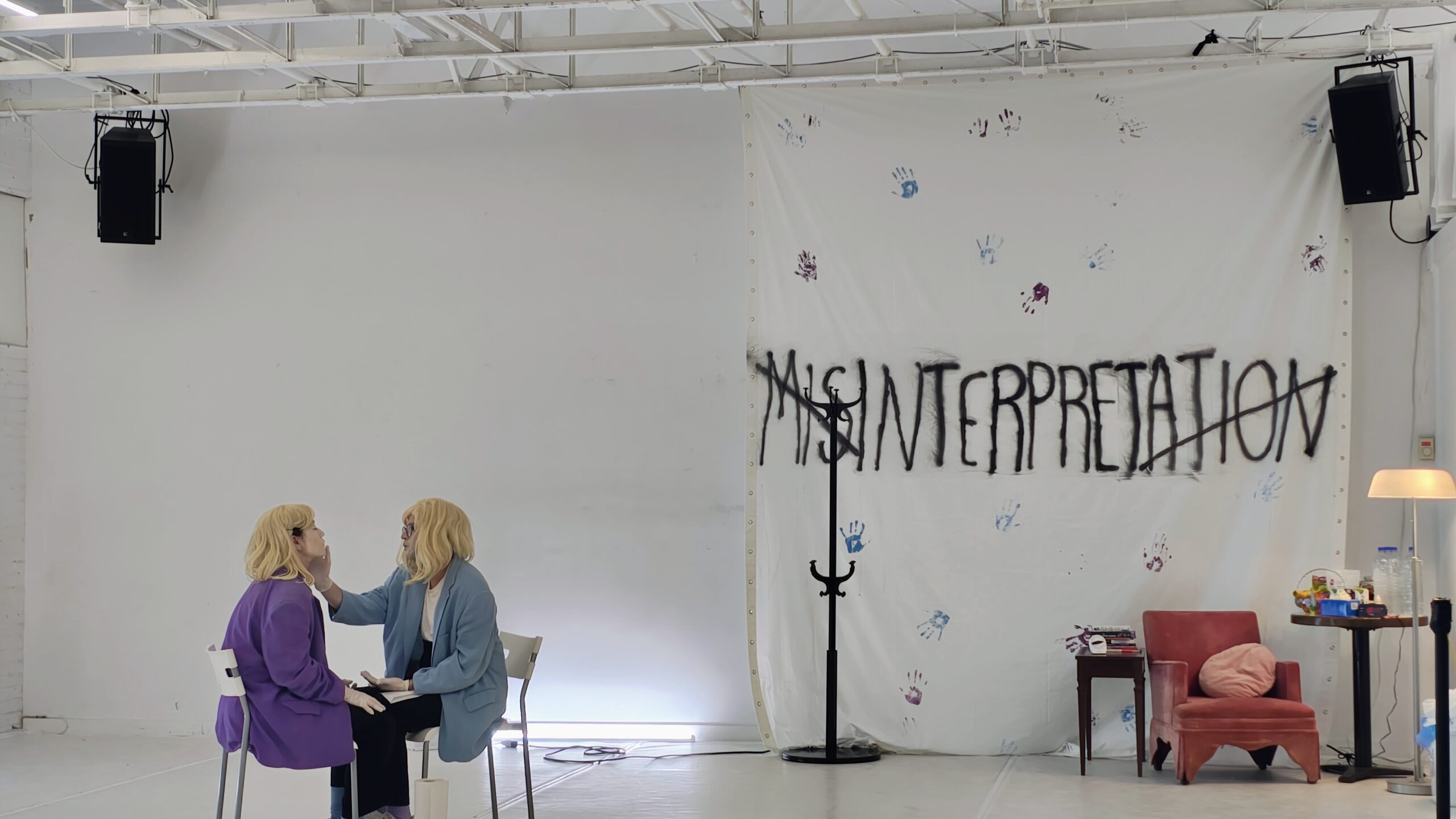
A practise is a durational performance that consists in a sequence of timeslots titled as sentences said in a recorded conversation played when the REAL SWEAT is on the You Don’t Agree That There Is Any Race At All part of the performance of whiteness. So, anyone who joins during the eight hours of a white-work-day can see Tia Ashley Kushniruk (亚 女弟) and Philip Jonah Logan Geller handling their whiteface androgynous clown-ish buffoons actions around topics such as You Don’t Know What a Canadian Looks Like, People Are Infinitely Complex and, well, The Universe.
The Same, for instance, is kind of ground zero – in the two first appearances of the section, Tia and Philip would retouch their makeup and clean up the space; for the third, they were having a McDonalds lunch. As the performance sort of “resets”, it becomes (white) clear that A practise is about the careful maintenance required to produce what can be perceived as natural. The REAL SWEAT is working hard to represent the nonexistent white race.
- Read more: access this link for more theater critics written in english
Brazilian artist Maxwell Alexandre (Rio de Janeiro, 1990), amongst other works known for his painting of black bodies within white cubes, recently opened his new exhibition in São Paulo named pintor preto, figuração branca – black painter, white figuration. Alexandre is proposing the creation of this new genre of painting: white figuration. For what was implicit need to emerge.
A practise, set in Centre de Création O Vertigo, also inhabits the white cube; the performance could also be presented in the black box – as the photo in the OFFTA website appears to indicate that has already happened – but there is something about the absence of contrast that aesthetically aggregate layers toward the work’s discourse. Whitefaces, white walls, white table, white chair, white light. White light, as an exact opposite of Denise Ferreira da Silva’s Blacklight, sheds their luminosity towards the lack of materiality of the most material of the power structures in the contemporary world. The white light is the complete transparency that does not allow any opacity, any mist in-between the relation of people; the complete transparency that rejects difference with such an intense brilliance that is incapable of realizing its own shadows.
What this Misinterpretation does to its audience is to literally urge them to interpret – the part of the performance name is stylized in a giant banner, the only thing in a wall apart from the whiteness of everything: misINTERPRETation. The satire is direct and intense, built by entangling whiteness, cisheteronormativity and masculinity, as Tia and Philip androgynous construction allows them to transit between the characters needed for each moment. The light stick is a phallus, table legs can be a phallus, and when they are representing male figures, everything is about a phallus and quite quickly homoaffectiveness becomes homossexuality – and that is a problem, a normative problem for them, as (then-)repressed sexualities are one of many intertwined elements that can defy hegemonies.
The juxtaposition of social localizations can be understood as what Édouard Glissant refers to as the West: not a place, but a project. A neverending colonial project. So, what A practise seems to do is unveil the well-known codes and push them towards the flaw, until their failure – and, mostly, it does not take much to disassemble fixated identities: such a powerful structure, such a fragile construct. Worker 1 and Worker 2 struggle with the simplest of tasks, taking them over forty minutes to set up a table, for instance. Within one and a half hours, their trash can is already filled and a total mess. Surrounded by a little string, they are there to be watched, but as an inverted human zoo, they feel like they’re the observers. No trespassing, no touching; the degree of interactions is at their command as they reveal delusions of purity and homogeneity.
A practise is about a dense, complex subject and also a funny performance to watch. There are some local commentaries (regarding Montreal, other locations in Canada and New York, for instance) but the content tends to reflect on the global village that our society – perhaps, specially the West – have been trying to build through acceptance and multiculturality, even though difference is not actually a great ingredient in this intended melting pot.
Then, a moment of enlightenment: the narration of a life story in topics, from early childhood towards “success”, with a sound ambience glorifying the nonsensical joy in what is being told. As the white loops never end, thesis of enwhitenment are listed and performed in A practise. REAL SWEAT chooses to approach whiteness from its expression – and perhaps the structure is so entangled to it that developing the identity to be dismantled from within might be enough.
They constantly acknowledge that there is an outside (and, apart from the performance, is there an outside for whiteness?), that there are borders, something beyond, a smell, the Other. And yet they remain inside, alert to the happenings that can nourish the Misinterpretation – a phone falls into the ground and they go crazy because “no electronics in the polycule!!”; the table is a victim of the unskilled white labor; toilet paper becomes a major jizz and the timetable can be a little stretched.
Amidst the excerpts names, two commentaries from the dialogue could be excellent dispositives: the affirmation that race Is a Fiction and the suggestion that it should be Replaced With Nothing. Conceptually speaking, race as fiction and race as nothing sounds like an amazing confrontation of quite distinct perspectives. What may go through the whole eight hours – and as these words are written, Worker 1 and Worker 2 are way off the clock – are the gestures of recognition, invention and confrontation. Through failure and mockery, A practise goes around subverting the thesis of enwhitenment for all to see its pathetic bases.