
social drama, Camp tragedy
amilton de azevedo writes about Querelle de Roberval (Canada), directed and adapted by Olivier Arteau from Kev Lambert’s romance, presented in the 2026 Festival TransAmériques (FTA – Tiohtià:ké/Montreal). the critic traveled to Canada at the invitation of the FTA and integrates the Playgrounds program with Critical Harvests.
“The sensibility of an era is not only its most decisive, but also its most perishable, aspect. One may capture the ideas (intellectual history) and the behavior (social history) of an epoch without ever touching upon the sensibility or taste which informed those ideas, that behavior.” (footnote on Susan Sontag’s Notes on Camp, 1964)
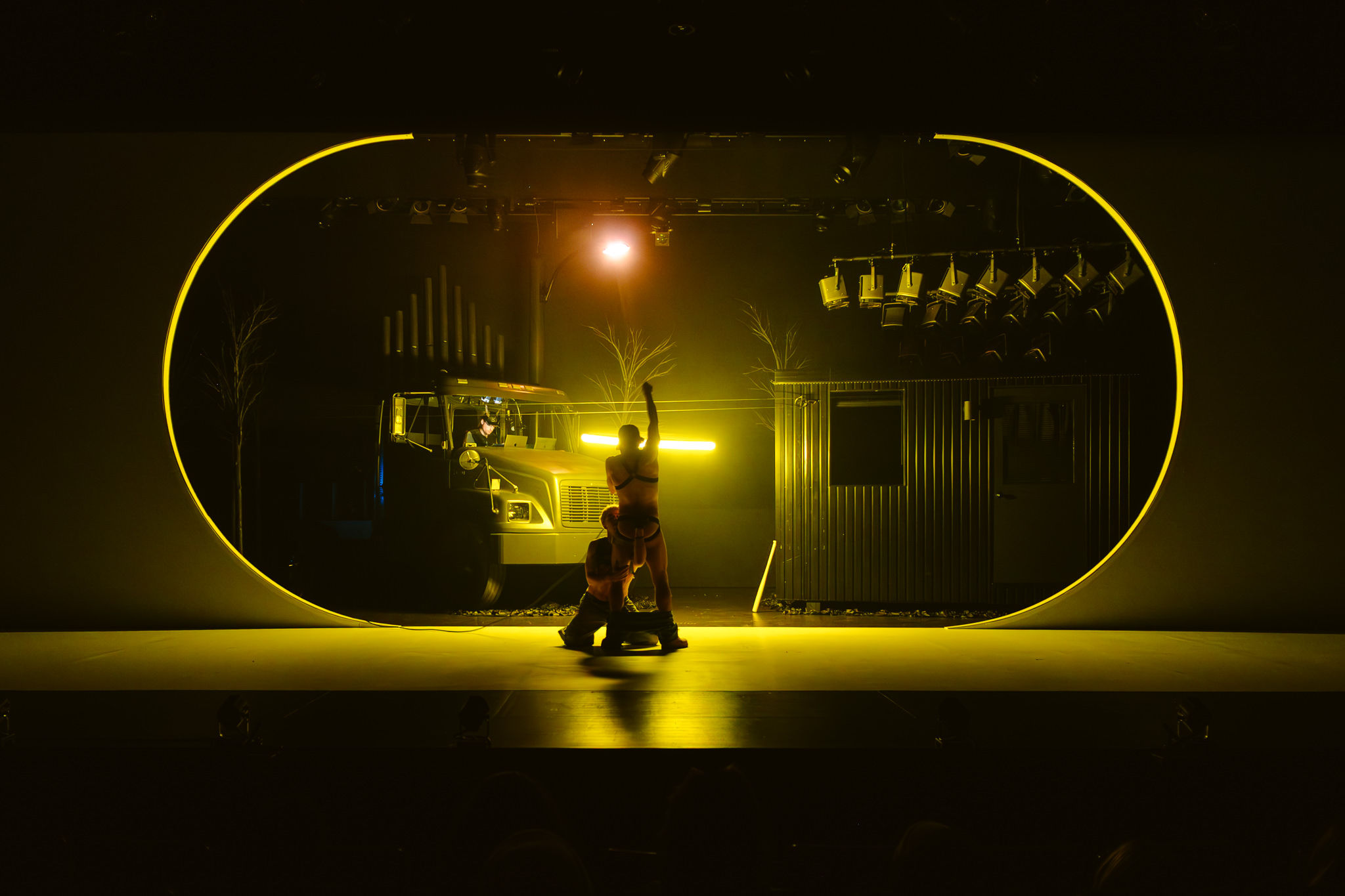
Right before saying that Jean Genet’s ideas are very Camp, Susan Sontag claims that “Camp and tragedy are antitheses”: there is seriousness, there may be pathos, it can be excruciating, but “there is never, never tragedy”. Well… I’m sticking with my title and my hypothesis that Querelle de Roberval – Olivier Arteau’s adaptation and staging of Kev Lambert’s romance – is, amongst other things, a Camp tragedy. For nothing can change my mind that the image of Querelle as Saint Sebastian, with sixteen reflectors (I counted) making that body glare, is absolutely Camp. As it is the ballet-esque pitched battle, as it is the hypersexualization of the play namesake. And exactly there is the hamartia: Querelle’s misfortune is being gay. Although one might say that (spoiler alert?) he could get killed anyway even if he wasn’t – houses are being burned, giant 18-wheelers are accelerating on the roads and becoming death traps, bleach is being poured in coffee cups, picketing is getting dangerous; nothing seems quite safe in Roberval.
Querelle does not put Roberval’s quarrel into motion as he is but one more piece on the board. A brief prologue sets the atmosphere and announces that there will be a murder; the introduction focuses on the behavior of that young, handsome man from Montreal. And then, in a straight line, as will be common throughout Arteau’s misé-en-scene, workers are on a strike, claiming for better conditions and making clear for the audience which part each one will represent in the social drama being set. Querelle de Roberval structures itself epically when it comes to announcing, commenting and opening the scene towards the audience; at the same time, some extent of naturalism is tensioning the theatricality – artifice and representation coexists but not peacefully; it is blurry.
- Read more: access this link for more theater critics written in english
- Read more: follow ruína acesa’s FTA 2026 coverage
Amélie Trépanier’s set design seems an attempt to frame the work as the white, artificial, front contrasts with the shadowy and abandoned nature behind. Querelle’s house is in the back, as it is the (totally Camp) 18-wheeler-organ-soundcabin. Lightbeams from Emile Beauchemin’s design cross through the performer-musician-truck-driver as they becomes part of that landscape, that left behind landscape – the immobility of the trees and of the truck coinhabits the same space of the busy cabin; the desire and drive of the Roberval’s youth of life and death are both there. It is the back of the stage, but it is the center, the framed, the vanishing point.
As the famous Antonio Gramsci’s quote goes, “The old world is dying. The new one is slow to appear. And in this chiaroscuro, monsters are born”: Querelle de Roberval seems to be precisely in this mix of shadow and light, where amidst the broken structures of extractivism and late-stage capitalism desires of revolution are diffuse – as it is in our current times, where the younger generations are more and more divided towards imagining radical futures through collectiveness and difference or through atomization and homogeneity. Class struggle and identity politics clash as the behavior and the ideas of our epoch are shown onstage and Arteau’s aesthetic appears to understand the impossibility to handle this without being a little over the top. As Sontag proposes on Notes on Camp, “the traditional means for going beyond straight seriousness – irony, satire – seem feeble today, inadequate to the culturally oversaturated medium in which contemporary sensibility is schooled. Camp introduces a new standard: artifice as an ideal, theatricality”.
Querelle de Roberval is a political Camp tragedy in its fiction layers, always assuming the theatricality but shifting how the narrative is told. Direct speech, dialogues, a joyful sound design, Brecht’s V-effekt, horror and humour: somewhat explicit, somewhat naïve, the show, with an openness to target a diverse audience, waves towards many relevant subjects in nowadays politics, sometimes pushing discourses in the direction of their flaws.
As the main antagonists – the sawmill boss and his class-traitor lady – are totally villainous built, Querelle de Roberval clearly takes a position towards the whole situation, even though it will not provide any answers on how-to by its end. It is not a bright horizon being shown ahead of us. Right-wing, conservative discourses grow within the working class, and The Internationale idea of “peace among ourselves, war to the tyrants!” seems like a long shot as workers are fighting workers and Querelle becomes the scapegoat of a quarrel that should not even be.
In its Camp approach of representing pleasure and violence, there might be a risk of how Querelle’s figure is read, as the character function can be perceived as being a queer menace and then being killed. At the same time, the character arc and what is made of it explore the idea of Being-as-Playing-a-Role; Camply enough, Querelle is not a gay man, he’s “gay”. The workers are “workers”, the lumbers are “lumbers”, the indigenous are “indigenous”: they are all there representing what they are the same way that they are not quite that; they are but a comment, a remark, an observation, a thesis.
Querelle de Roberval finds interesting ways to insert aggressions onstage, mostly by choreographing it in non-realistic or partially hidden manners, in a similar approach that it does to sexual interactions. Navigating between realism and dreamlike scenes, beautiful moments share the stage with more raw ones, amalgamating its pieces throughout composition and interruption, with Jézabel’s gaze being the main conductor for the story unfolding. There is a lot in Querelle de Roberval, much to be caught, much to be left loose: a straightforward social drama, an ungraspable Camp tragic twist; a theatrical take on the sensibility of our times.