
as the last bell is yet to ring
amilton de azevedo writes about The Chains (Canada), produced by Evan Webber + Public Recordings, presented in the 2026 Festival TransAmériques (FTA – Tiohtià:ké/Montreal). the critic traveled to Canada at the invitation of the FTA and integrates the Playgrounds program with Critical Harvests.
Lines marked on the floor, tables carefully arranged through the room, four chairs around each. Over the tables, four pencils and four answer sheets. Also, two bowls – one for cherries, one for its seeds. You can pour yourself a cup of water and there is a pencil sharpener available if you need it. Evan Webber walks around and distributes the test-slash-script. I question him if I should open and begin reading it; he says we’ll do it together. The Chains is a participative three-acted performance. An attempt on what we do regarding the people and the world around us. Even knowing the structure of the work, it definitely can feel like one is joining the Antigone Club without any idea about who Antigone is and how a club operates.
Webber announces that we will have forty-four minutes to answer the 22-question test. We should read it out loud, together, and reply individually. A personality test where every interrogative is followed by a piece of narrative. Sophocles’ Antigone underlies everything as we become a “you” from a 90s high-schooler perspective. References to Ontario politics can be missed, but the criticism towards neoliberalism from those young anarchists can’t. In a specific moment, The Chains kind of gives out Remember Me (the 2010 movie) vibes as the 9/11 proximity is revealed; it can offer a gasp as we read the test-texts as a short story being unfolded, but at the same time is another of the anchors being set up by the storytelling.
- Read more: access this link for more theater critics written in english
- Read more: follow ruína acesa’s FTA 2026 coverage
Taking tests may or may not be fun. It is probably more stressful than cherishable. As we are on the clock, Webber is walking around the room as a school monitor, checking if everything is going well at each table. Sometimes the questions are promptly answered, sometimes it takes a little more reflection; sometimes, none of the alternatives seems to fit. As one feels some of the questions are amusing and easy, the second act will reveal that other people might think of them totally differently. At the same time, “your” narrative alongside Gabriel and Ley takes some unexpected twists amidst what was already understood, and the relation between the story and the test, between The Chains and Antigone and Ontario and the War on Terror, is not entirely open to grasp.
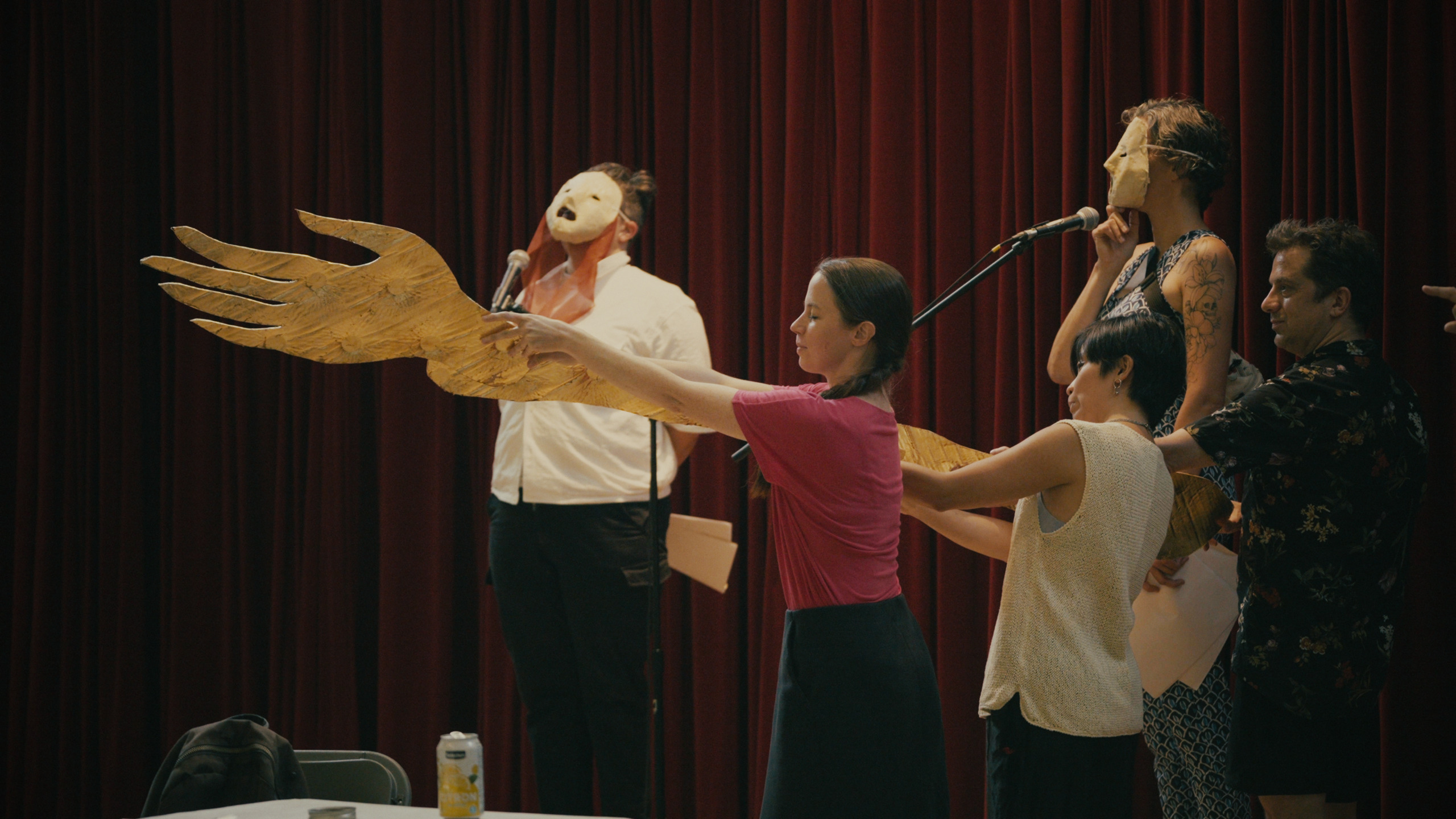
As the tests are being taken, one can think about where The Chains is going. There is a big brown banner with the painting of a foot. Two microphones are arranged in front of it. Some cases are being moved around. It was a hot day in Montreal, but the fans spread around the communal room of Cité-des-Hospitalières en transition seemed to be more for the soundscape than the wind itself. When they’re turned off, we experience an almost-forgotten silence. The bell rings and test time is over. Then, time for the results. For the second act, we become the kept-unclear Antigone Club to perform a rendition of the tragedy. Groups are divided between characters; on the June 4th performance during the Festival TransAmériques, our section had only one Antigone – one can wonder if it was a set-up or if the performance gods were great to us.
Since I became the Chorus corypheus and had to be aware of cues and actions and building a wall, all that while wearing a mask, I wasn’t able to actually see the mise-en-scène put into motion; it seemed to inhabit a place between solemn and kitsch, as it was impromptu made. Later-Antigone is setting the mood with the sound effects, Antigone hand is posed as to plead, Creon’s hand is pointy, bossy; and the Chorus, the city, is fulfilling functions – collectiveness can also become a hivemind mass.
The sort-of-reenactment finishes with a question being asked and repeated, answerless. (And since I was unconsciously-responsible for the one chosen in my session, I found it to be deeply suited for the ending). The Chains final act reinstates its name, as the chain’s image from a specific perspective was already brought in by the test and, in that last moment, Webber’s collective invitation subverts it entirely. To bury the dead, to contemplate freedom: to reckon how social matters take a toll on one’s subjectiveness – and vice-versa. The Chains, a shapeshifting work, seems to homage those who lived and loved, understanding how personalities are also constructs of the environment and provoking around how we handle ourselves, those around us, the structures that sustain the world as it is and what could be done to transform them. As the last bell is yet to ring, everything is still in motion; answerless.