
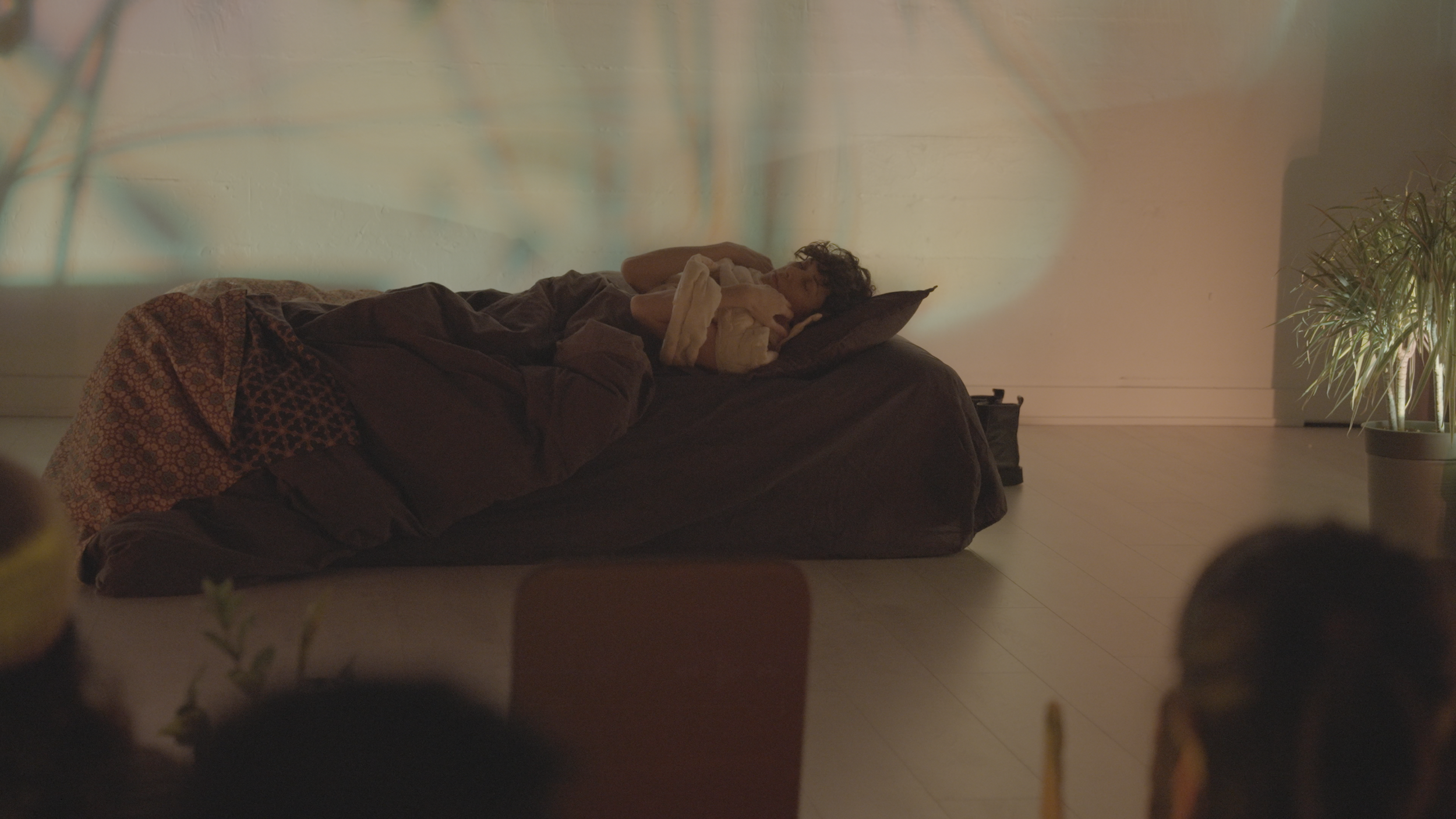
even in dreamscapes one can’t avoid looking for bombs crossing lysergic skies
amilton de azevedo writes about Seeing Double, by Ghinwa Yassine (Lebanon/Canada), presented in the 2026 OFFTA – Live Art Festival (Tiohtià:ké/Montreal). the critic traveled to Canada at the invitation of the FTA and integrates their Playgrounds program with Critical Harvests.
“One of the many reasons human cultures have long associated sleep with death is that they each demonstrate the continuity of the world in our absence. However, the only temporary absence of the sleeper always contains a bond to a future, to a possibility of renewal and hence of freedom. It is an interval into which glimpses of an unlived life, of a postponed life, can edge faintly into awareness. The nightly hope for the insensible state of deep sleep is at the same time an anticipation of an awakening that could hold something unforeseen.” (Jonathan Crary, 24/7: Late Capitalism and the Ends of Sleep)
One bed. One camera, meters and meters directly above it. Plants. Indirect, cozy lightning. Idyllic landscapes being travelled, distorted footage of real bombstrikes. A person wearing grey lycra and a wig walks around, turning on the little lamps, entering their own bedroom. An intimate environment, a space for sharing dreams and nightmares. Aliens, wars, the blissful possibility of orgasm oneself to another planet. The universe, interdimensionality, the oniric. Ghinwa Yassine’s Seeing Double might be about rest and restlessness, about what is determined and the attempts to escape fate.
As all lights turn blue while Yassine describes herself as the woman lover of the aquatic creature of The Shape of Water, the entire audience is within the aquarius that is made of Tangente’s Espace Vert. Seeing Double is an invitation into hypnagogia, as what is narrated dwells between states of consciousness, degrees of fiction and sleepiness – Yassine’s voice is being heard almost monotonous-ish as we all create those images, projecting them into the space and building them within us. Vivid dreams, blurred realities.
- Read more: access this link for more theater critics written in english
To dream, to describe, to create. Sometimes the audience might not follow as narrative layers unfold themselves and we try to grasp on the meanings being built and how they relate. Family, working with art, making a living, the past, the present. Structured as a oniric tale, Seeing Double makes Yassine hear Yassine, as if her thoughts are for all to listen. Afar from bedtime stories, dreams and daytime nightmares coexist within the narrated and the images being projected.
So we are in the bedroom, we are in her hometown, we are in outer space. Nothing might be what it seems at the same time that everything is exactly what it seems. Seeing Double: the awake, the asleep; here and there; now and not. Yassine embraces doubleness as the performer literally hugs the organic-fluffy-thing-creature-costume. It is about an artist’s dreams and desires, real or fictitious, and about what is inescapable. Even in dreamscapes one can’t avoid looking for bombs crossing lysergic skies as Yassine’s Lebanese origin is intertwined by memories of war and so it is her practice (and, maybe, the audience’s expectations also).
Laying in bed, she avoids staring at the camera for many of the chapters. Until she looks up. Yassina looks into the camera, but maybe she’s aiming above, for the stars. The image, though, sided by the records of missile strikes, is an aerial view that resembles drone footage from war operations. As if the camera itself is a weapon ready to drop bombs even in her sleep. And she is an intergalactic being from oniric dimensions. Seeing Double structures, in its own hypnagogic manner, a(n im)possible attempt of deviating from the inevitable fate assigned at birth(place).