
the gospel of Mother Elle
amilton de azevedo writes about AUTOGYNEGAMY, by Elle Barbara (Canada), presented in the 2025 Festival TransAmériques (FTA – Tiohtià:ké/Montreal). this text is part of a special coverage; the critic traveled to Canada at the invitation of the FTA.
“The funeral is the artist’s last art piece before leaving” (An Artist’s Life Manifesto, Marina Abramović)
“If you can’t love yourself, how in the hell you gonna love somebody else?” (Can I Get an Amen, RuPaul)
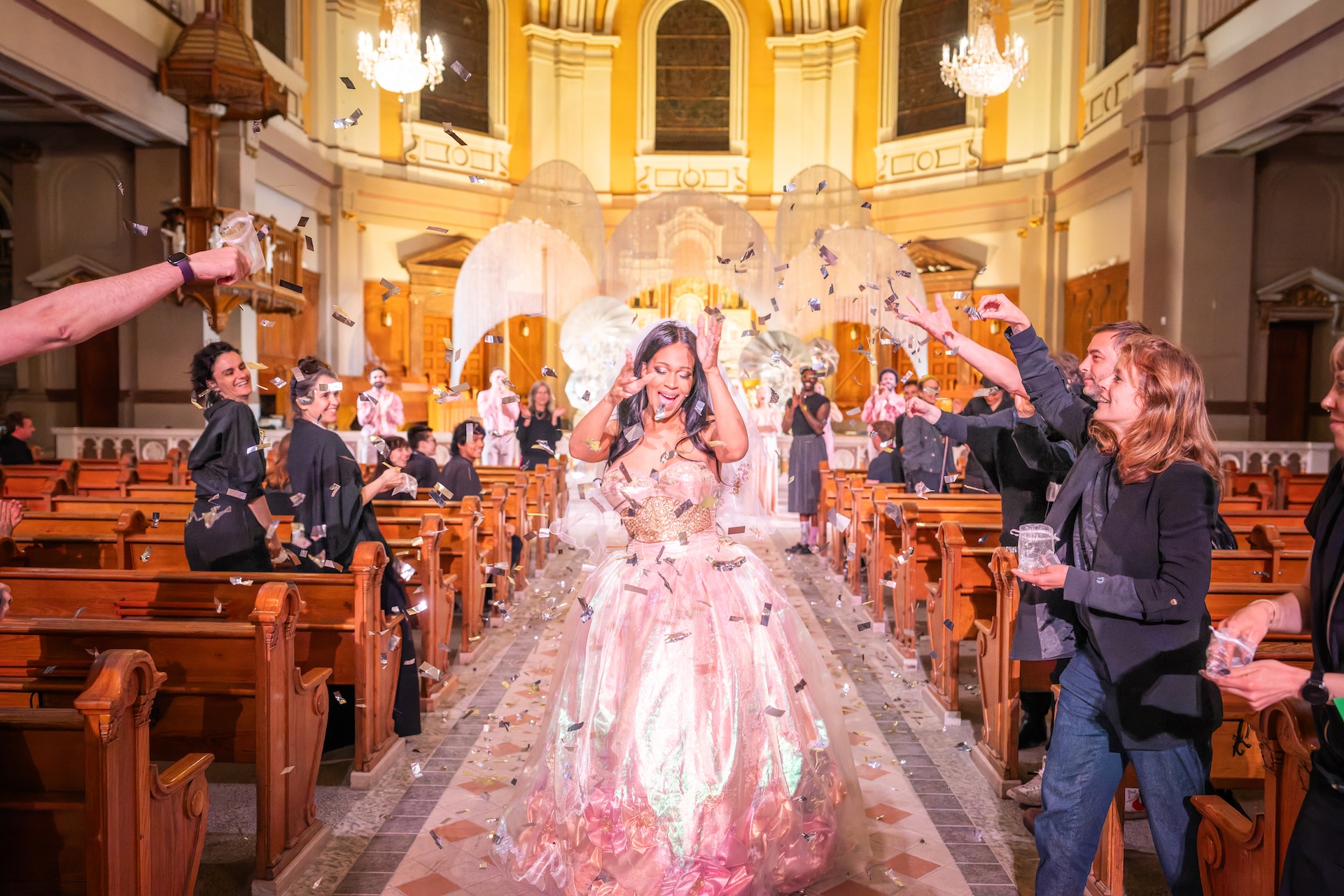
When Elle Barbara’s wedding guesses – the audience – walks in the Church of the Holy Redeemer (also named Théâtre Adam in the FTA venues webpage), an astonishing revelation: it is her funeral, and we are there to honor her memory. As the mourning cast members sits on the nearest place around the coffin, one woman cries so loud that is hard not to laugh. Then, Reverend Father (as named on the programme) Daniel Parent takes on the altar-stage, and AUTOGYNEGAMY begin building its liturgy. Within the preaching, the audience – friends and family of the late Barbara – is informed that her new (posthumous?) album Word On The Street is on presale on the artist’s bandcamp.
The bible and the ballroom: both camp and gracious, AUTOGYNEGAMY is a celebration through a five-act ceremonial for more than the wedding of Barbara with herself – it is the gospel of Mother Elle. She is Eve, expelled from Eden, pole dancing in the church, as profane and sacred entangles themselves. She is Christ, crucified, resurrected, building community. Biblical narratives are presentified by Parent’s vociferous preaching, as Barbara goes through her death and funeral, renaissance, damnation and sacrifice until the moment for eternal love, bonding with herself, her trajectory, her existence as a Black trans woman.
They are all somewhat clear metaphors that can be read both in an biographical perspective (related to themes and moments of Barbara’s life) and in a collectively representative story. Being the Bible a founding mythology for many societies around the world – even if one is a nonbeliever, there is something of the unconscious that is affected by its impact – it is quite understandable how AUTOGYNEGAMY playfully organizes its materials around the message aimed to be sent throughout its mise-en-scène. And it is about Barbara, but is even more about building community.
- Read more: access this link for more theater critics written in english
- Read more: follow ruína acesa’s 2025 FTA special coverage
It may seem strange that the “character arc”, so to speak, is presented in a linear, redeeming manner, as even the idea of death preceding life also works in such direction. One could argue that this kind of storytelling is long known to operate within hegemonic discourses. So that might be the catch: as Barbara and her team appropriates themselves of such structure, the mirroring of biblical passages onto her persona (for she is both a performer and an actress in AUTOGYNEGAMY) is in itself a subversion of the discourse. Barbara’s role on Black queer community in Montreal – “Given my role in ballroom, a lot of people started referring to me as a mother of the scene”, she mentions in an interview for Xtra Magazine – is sort of the enabler of overlapping herself with mythical figures from the Bible. Again, AUTOGYNEGAMY is the gospel of Mother Elle.
For those unaware of the artist’s background, the work may not be fully reachable in all of its layers, but it still sustains itself. There is much to be read within AUTOGYNEGAMY, not only because of its biblical referring – embodied by Parent’s acting – but mostly for Barbara’s work with Sasha Kleinplatz (in choreographies) and Enora Rivière (in writing); also, the production dramaturgy by Raja Feather Kelly. Working within the specificalities of the venue, the show faces some limitations towards its visibility by all the spectators, considering the church’s architecture. At the same time, it might be hard to visualize AUTOGYNEGAMY being staged anywhere else. Strong images are built around the whole space, as the ensemble changes their functions around Mother Elle stardom. Corridors, galleries, the altar: everywhere can be a set (through Marilène Bastien’s designs). The use of elevated platforms is an intelligent solution – still, not everything will be seen by everyone. But the vibe is there for all to witness; to be a part of it.
Literal participation takes part in the fourth act (named third, since it begins on act zero), the Eucharistic intermission, when everyone is invited to commune – and Parent’s portrayal of a reverend seems to enjoy every interaction. Also, right at the beginning of the funeral, people who knew Barbara are asked to say a few words; during the saturday, May 31st, presentation, only one person walked to the microphone on the stand – what appeared to be an staged action. Considering Barbara’s presence on Montreal’s scene, maybe with more time more (actual) audience’s members would step up. Then, when her father (played by H. Nigel Thomas) talks about his daughter, an apologizing speech on failing to be a dad touches on masculine fragility at the same time that he refers, not once, as a dead son.
Violence is there within words and will be present in confrontations, compositions and actions. Considering Black queer lives, it seems almost unavoidable. It might be about how to respond – and Barbara’s artistic gesture of restitution and recreation begins at the performance title: as the artists tell in her interview for the FTA website, AUTOGYNEGAMY is a word she made up “combining the Greek words αὐτό (“auto”), which means the self or oneself, γυνή (“gyn”), which refers to women, and γάμος (“gamie”), meaning marriage or union”. She continues, mentioning that it is also a reference towards Ray Blanchard’s theory on “autogynephilia” – a continuously-being-debunked and transphobic concept to explain transgenderism.
Blanchard’s idea is that a “non-homossexual” (he would consider a transgender woman attracted to woman being “straight”, as his theory sort of mixes up gender identity and sexual orientation) transgender woman would be trans because she is a men sexually aroused by the thought of himself as a woman. By substituting “philia” with “gamy”, obsession is replaced with bonding, union. Barbara’s twist performed on AUTOGYNEGAMY is that, despite one can see parts of the performance as erotic, the desire to marry herself has absolutely nothing to do with sex, nor is an egoic fantasy that revolves around her own act.
Of course, she is the star in the center of everything being put into motion by AUTOGYNEGAMY. However, it is not about how bright is her light as much as is about the warmth that it provides to all that can be attracted by such a gravitational force. Barbara’s marriage with herself is a celebration of self love, as if after so many probations throughout life one can always find oneself at any point of the line; every end being a beginning. Once the wedding is consumed, the overemotional mourner from the earlier funeral is still wearing black as she cheerfully hugs the newlywed; in the gospel of Mother Elle, amidst reality and fiction, theatricality and performativity coexists camply.